The Origins of Handmade Textiles in the UK
Do you remember back when people would pass down textiles that belonged to previous generations? Well, in the UK, this was quite the norm. With textile cottage industries booming, people would buy articles of clothing or furnishings that were made to last. And so, even when they passed on, these items remained as a reminder of these loved ones, which made them all the more special.
According to the archaeological finds we have to this day, people in the UK started spinning wool and flax thousands of years ago. The goal back then was to create fabrics that could provide warmth at a time when survival hinged on the ability to literally weather the storm. Over the centuries, the Brits interacted with the Romans, who introduced them to advanced spinning techniques, complete with tips on how to cultivate linen and dye their fabrics. With these changes, textile production became a bit more organised, and it was not long before Brits started putting up workshops to supply armies and settlements with fabric.
The Cottage Industry Boom
By the 12th to 14th centuries, English wool had become such a prized raw material that other regions would import it. It was around this time that weavers, dyers, and fullers came together to form guilds in a bid to regulate the quality of wool. And the more they spun, the more the cottage industries grew, and the more wealth they accumulated, to the point that their profits were even funding churches and other projects. Specialisation came soon after, where we saw each region choose its speciality. From fine wool in the Cotswolds to heavier cloth in Yorkshire and serge in Devon, wool was no longer just a fabric. It was now a symbol of local identity.
The Industrial Revolution
The Industrial Revolution reared its head towards the 18th and 19th centuries when inventions like the power loom and water frame became available. Soon after that, mills started making cotton and wool on a much larger scale than the cottage industries. This change was a double-edged sword. On the one hand, it made textiles more affordable and provided employment to thousands of people. But on the other hand, it resulted in a lower demand for handmade items, which had a significant negative impact on cottage industry revenues. Even so, many cottage industries, especially in rural areas, kept up with their hand traditions, which are alive to this day.
Are Handmade Textiles Really Different?
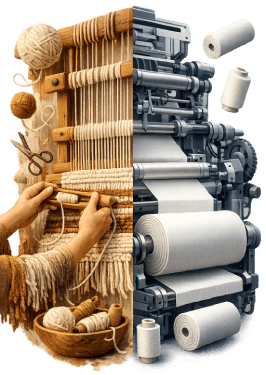
Anyone who has bought an artisan or homemade textile knows that this often comes at a steeper price compared to factory textiles, which we refer to as mass-produced. But is the difference between the two just in the cost? Not at all. In fact, the price explains the distinctions between the two methods. How?
First, there is fibre integrity. When people spin fabric with their own hands, they use long-staple virgin natural fabric because they know that they can preserve the natural oils and strength in the fabric. But with the factory-produced textiles, you find that manufacturers often rely on shorter fibres of these natural fabrics or synthetic blends because they want something that can withstand the tension in the machines.
Next, uniqueness comes into the picture. With handmade fabrics, every item varies from the other due to variations in colour, tension, and other human elements. So, each piece has a story. But with mass-produced items, there is perfect uniformity as the products match the settings in the machines.
And, of course, we have durability. Handmade items are made to last, while mass-produced items are often designed for efficiency. What’s more, with the fast fashion trends in this digital age, most manufacturers pay little mind to quality as they know that these items will be out by next season.
The Role of Textiles in Interior Spaces
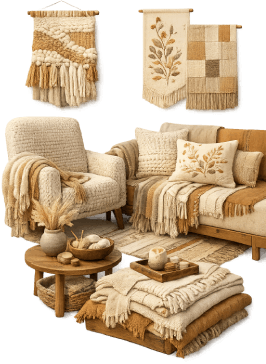
Handmade textiles are not only seen on clothes racks. They are also present in cushions, fabric paintings, and upholstery. Take cushions, for example. These were once luxury items for the nobles, which featured silk or velvet coverings and feather fillings. It was not until the 17th to 18th centuries that they became available to the middle-class population. Now, it is quite common to buy these handmade cushions from artisans who make them with linen, wool, or cotton before adding some embroidery work for those final touches.
Even with all the mass-produced alternatives in the market, you find that many people in the UK reach for these handmade items. Why?
To start with, these handmade items serve as an ode to the traditions in the UK. Whether people are leaning on plush embroidered pillows or an armchair with handmade fabric, they get to take a journey back in time.
Secondly, these fabrics add depth and warmth to rooms, making them feel layered and more authentic. They easily add character to any room and are an easy way to impart individuality in a world where the same has faded. In fact, they can serve as statement pieces, especially when blended in with modern elements.
And finally, they are sustainable, not just in their durability but also in the processes undertaken in making them. As more people embrace eco-consciousness in the wake of landfills and consumerist culture, slow craft has taken over the scene, and these textiles match the movement.
A Quick Look at Resilient Handmade Traditions
As much as the factory-produced fabrics may be cheaper and more accessible around the world, the UK still boasts a wide range of cottage industries that have held on to its textile traditions.
Harris Tweed in Scotland is a great example. It dates back centuries, when crofters would use hardy local wool to weave tweed. And thanks to laws that have been in place since 1910, this kind of weaving must be done by hand and in local homes, which allows crofters to continue making fabrics for use in interiors and fashion while staying true to their Scottish roots.
Welsh tapestry blankets, which have often been passed down as heirlooms, are also highly sought-after. While their boom was in the 18th and 19th centuries, they still appeal to buyers all over the UK and beyond. And it all comes down to their intricate double-cloth weaving technique that creates beautiful geometric designs.
And if you are curious about the medieval traditions that funded churches and guild halls, Cotswold wool weaving is still alive to this day. Artisans are known for working on small-scale projects that are just awe-inspiring.
Tons of other traditions still exist, from Shetland Lace to Irish Linen and Fair Isle Knitting, all of which add a unique twist to hand-making.
Details matter... a closer look at the incredible details on the furnishings in the Petit Trianon at Versailles: floral embroidery, cord trimming, wood carving, polychrome finishes. pic.twitter.com/jU3SlTj6uK
— Elle Lookbook (@EvaLovesDesign) October 25, 2025